
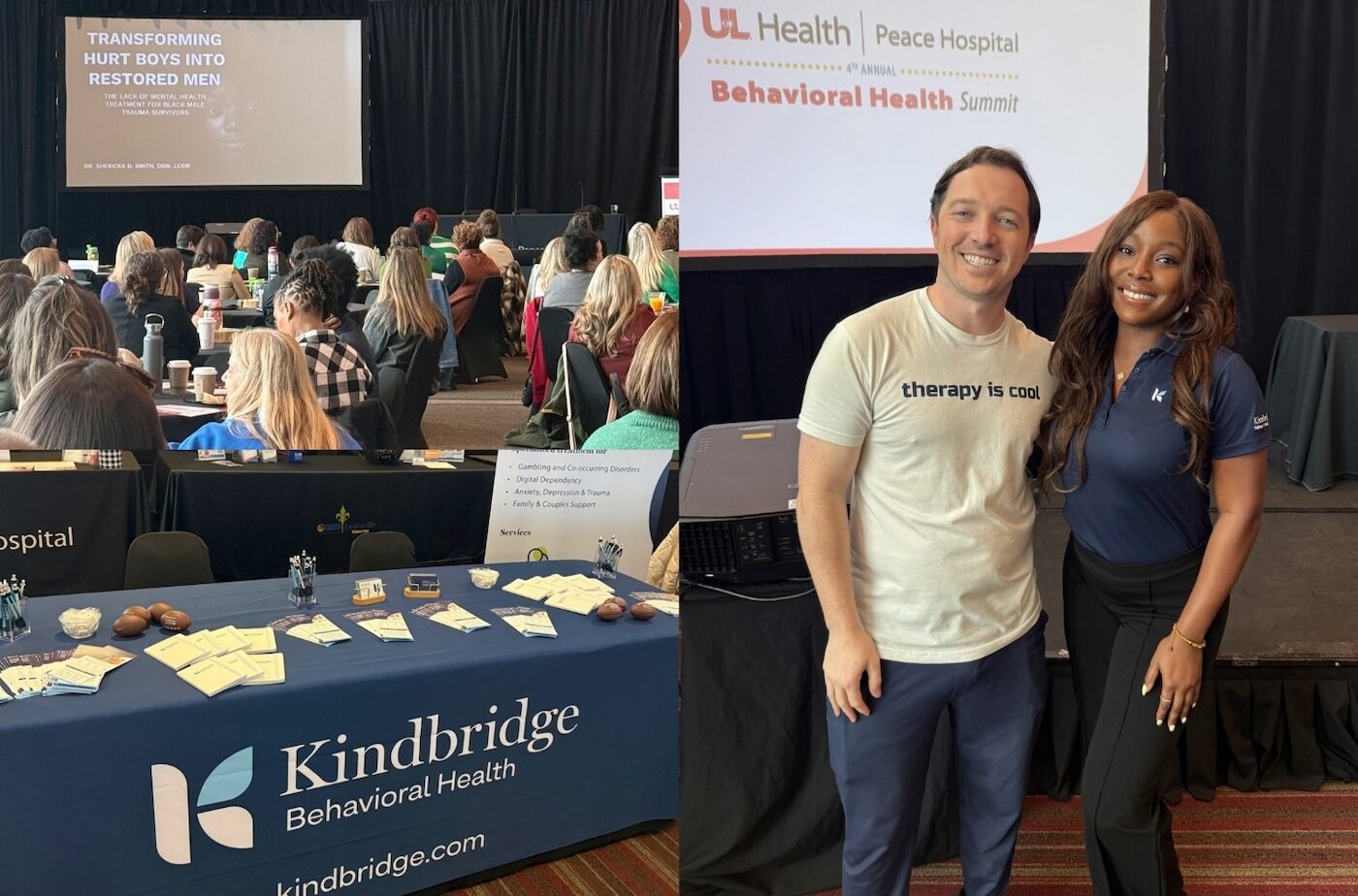
UofL Health is a not-for-profit, academic health system under the umbrella of the University of Louisville, serving Kentucky and Southern Indiana. It is anchored by a mission of compassionate, patient-centered care, featuring nine hospitals, four medical centers, over 250 physician practices, and more than 1,200 providers.
Since inception in 2023, UofL Health | Peace Hospital has hosted the Behavioral Health Summit, an annual, full-day affair focusing on critical mental health topics, featuring expert speakers, interactive learning, and community collaboration. The aim of the gathering is to reduce stigma, provide education, and address various topics relating to mental health among vulnerable populations and innovative treatment strategies.
This year, Kindbridge Behavioral Health was grateful for the opportunity to sponsor and participate in the 4th Annual Behavioral Health Summit. It brought together clinicians, health system leaders, and community partners for a day of dialogue centered on how behavioral health is evolving, and what it will take to better support individuals earlier and more effectively across the continuum of care. Opening remarks by UofL Health | Peace Hospital’s CEO, Keith Rankin, evidenced an emphasis on collaboration, access, and the need to continue evolving behavioral health systems to meet increasingly complex and interconnected needs. The summit effectively balanced clinical education, panel discussions, lived experience, and systems level dialogue. Sessions ranged from psychiatric care and substance use treatment to trauma, identity, and innovative therapeutic approaches – creating a space where both data and human experience informed the conversation.
A shared sentiment regarding behavioral health was felt throughout L&N Federal Credit Union Stadium in Louisville, Kentucky, on March 17, 2026. It was – and continues to be – ubiquitously understood that behavioral health is no longer isolated, but something that is shaped by environment, identity, access, and lived experience.
Waves of content from those participating in the 4th Annual Behavioral Health Summit will be unveiled as the days and weeks pass, but to keep readers informed, Kindbridge has put together a succinct recap. Below is a summary of highlights and takeaways along with a look at Kindbridge’s involvement at the important event.
Highlights and Key Insights from UofL Health | Peace Hospital’s 4th Annual Behavioral Health Summit 2026
I. Session Highlights & Key Insights
A. CENTERING CULTURAL CONTEXT IN CARE
“From Hurt Boys to Restored Men: Prioritizing Mental Health Treatment for Minority Trauma Survivors” (Dr. Shericka D. Smith, DSW, LCSW)
Dr. Shericka Smith (view bio) delivered a powerful session emphasizing the importance of integrating cultural and lived experience into mental health care. She highlighted how experiences such as microaggressions, racial profiling, systemic interactions, and identity-based fear directly impact mental health outcomes.
Key takeaway: Effective care requires culturally reflective questions – not just clinical assessments. This reinforced the importance of health equity and context-aware care models.
B. ADVANCING PSYCHIATRIC TREATMENT & CONTINUITY IN CARE
The “Psychotropics and Long-Acting Injectables” panel featuring Dr. Stephen Taylor, Aly Indan, APRN, and Rachel Carrigan, RPh focused on how innovations in psychiatric treatment – particularly long-acting injectables – can improve medication adherence, stability in care, and long-term outcomes.
Key takeaway: Sustainable outcomes require consistency, not just access.
C. LIVED EXPERIENCE AS A LIFELINE TO EARLIER SUPPORT
Keynote speaker, Brandon Saho, stood out as one of the most impactful voices of the day. His discussion was grounded not in theory, but in lived experience. After years of struggling with depression, suicidal thoughts, and alcoholism, Brandon made the decision to seek help, which was a turning point that ultimately led him to redefine his purpose (view more). Through his platform The Mental Game, he uses that experience to normalize conversations around mental health, encourage individuals to seek help sooner, and create space for others to feel seen, understood, and supported.
Key takeaway: Brandon’s message at the summit was clear and urgent, suggesting that too often, people wait until they are at their lowest point to seek help ,when earlier connection could have changed their trajectory. By sharing his story, Brandon is not just raising awareness, he is actively working to save lives by shifting when and how people engage with support. Details on his program – Engage – can be found here.
D. UNDERSTANDING SUBSTANCE USE THROUGH A LONGITUDINAL LENS
The “Alcohol Use Disorder: Pathology and Treatment” session by Dr. Vatsalya Vatsalya (view bio) emphasized the importance of understanding substance use over time, including, drinking patterns across the lifespan, relapse monitoring, and post-treatment follow-up.
Key takeaway: Behavioral health requires longitudinal insight, not episodic care.
E. EXPANDING THERAPEUTIC APPROACHES
The “Music as a Tool for Health Transformation” session by Jessica Heinz, MT-BC, CPC (view bio) explored how alternative approaches, such as music therapy, can support emotional processing, engagement in care, and patient-centered healing.
Key takeaway: The session reinforced that effective care must meet individuals in ways that resonate beyond traditional models.
F. EMERGING SIGNAL: YOUTH, DIGITAL ENVIRONMENTS, AND BEHAVIORAL HEALTH
This session covered something that was touched on by other summit discussion. It made it clear that behavioral health in this modern era – particularly among younger populations – is being shaped by digital environments, evolving social dynamics, and new forms of engagement. These factors are influencing identity and behavior earlier, creating new patterns of stress, and making early indicators of risk harder to recognize.
Key takeaway: Many behavioral health challenges are emerging earlier, but are still being addressed too late.
II. Elevating Awareness: Problem Gambling & Co-Occurring Needs
As a sponsor of the 2026 Behavioral Health Summit, Kindbridge was proud to contribute to broader awareness around problem gambling and its intersection with behavioral health.
The discussion highlighted that problematic behavior regarding casino gaming and sports betting often co-occurs with issues such as anxiety and depression, financial stress, and relationship strain, yet frequently remain under-identified, particularly in early stages. The conversation also identified a growing opportunity to better integrate screening, education, and referral pathways into broader behavioral health systems.
III. Core System-Level Takeaways
Across the summit, several themes emerged. These included (but were not exclusive to) the following:
- Behavioral health is increasingly shaped by external and systemic factors.
- Early indicators of risk are often missed within traditional models.
- Workforce training must evolve alongside emerging needs.
- Care systems remain fragmented, impacting access and outcomes.
The overarching message was that the opportunity ahead is not just about expanding access, but improving how systems recognize, respond to, and coordinate care earlier.
Moreover, conversations throughout the summit closely reflected what we at Kindbridge Behavioral Health are seeing across our work. Key observations include the following:
- Behavioral health challenges increasingly intersect with financial behaviors and digital environments.
- Individuals often show signs of risk well before entering traditional care pathways.
- Systems are seeking more effective ways to identify, educate, and connect individuals to care earlier.
Conclusion
Gratitude + Forward Momentum
We’re grateful to UofL Health | Peace Hospital for hosting a thoughtful and impactful summit that continues to move the field forward. As behavioral health needs continue to evolve, collaboration across health systems, plans, and community partners will be essential in building more connected, responsive models of care. Kindbridge looks forward to continuing these conversations and supporting efforts that strengthen how individuals are identified, supported, and connected to care – earlier.